
Picture this
1. What is your business about? What products/services does it sell? What benefits does it offer?
All this information is available across platforms where your target audiences are looking for you.
2. All the channels where your customers land are connected.
Meaning, if your customers leave a product in the cart, in the next hour, you can send a notification mentioning “please complete your purchase before it gets out of stock,” or you can also feature those same products in social media ads.
That’s exactly what cross-channel marketing lets you do.
Now, you might be thinking! If that’s the case, surely 80-90% of them would convert, a great sales figure! Let’s start!
And, the next moment, an epiphany strikes, and you ask yourself—is it really possible, being present on all channels(connected) in such a complex landscape?
Yes, it is!
Keep reading the blog carefully, and get an in-depth insight and framework on:
What is cross-channel marketing?
How does it work?
What are the tips, tricks, and strategies for conducting cross-channel campaigns?
Why is it beneficial for businesses?
What are the challenges faced?
How to deal with those challenges, and more!
How is cross-channel different from multichannel and omnichannel marketing?
Without further ado, let’s get started!
Cross-Channel Marketing: What is it?
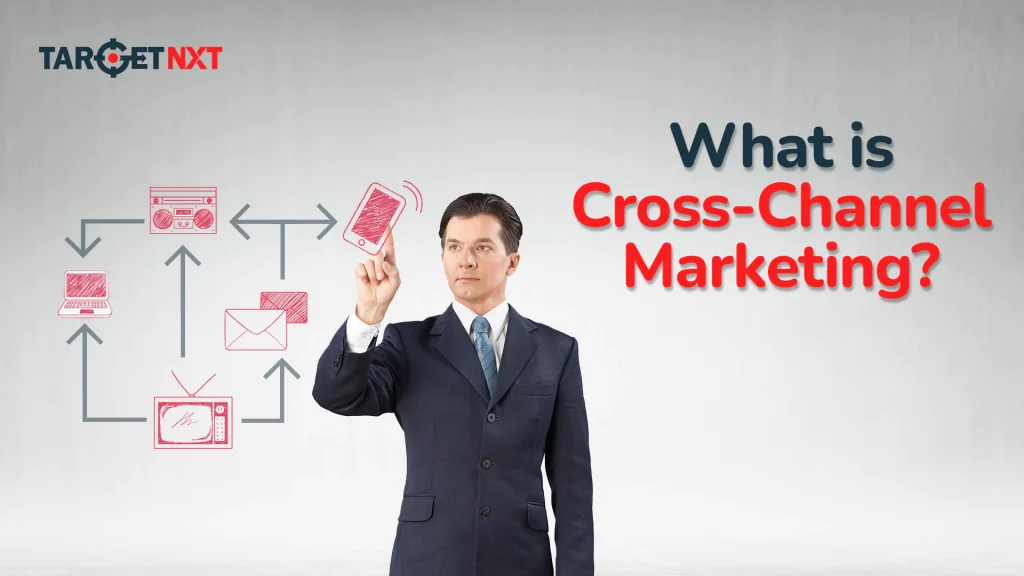
Cross channel marketing is a strategic approach for organizations looking to deliver a more engaging and cohesive customer experience across all channels. By incorporating efforts across various platforms, brands increase engagement and build stronger brand recognition.
Here, all the channels are interrelated, meaning that whatever actions a customer performs on one platform are immediately passed on to another.
Let’s take an example, consider you went to an offline store to purchase some clothes, when you came back home, you already had a sms notification from the store, and then you downloaded the app, you see they feature the same recommendations as you asked in the offline store.
So, here you can see, offline stores(in-store interactions), SMS, mobile apps, etc., are all connected, delivering a cohesive and personalized buyer journey.
Now, you might have got the basic understanding of “what exactly is cross-channel marketing”.
Let’s delve deeper!
How Does Cross-Channel Marketing Work?
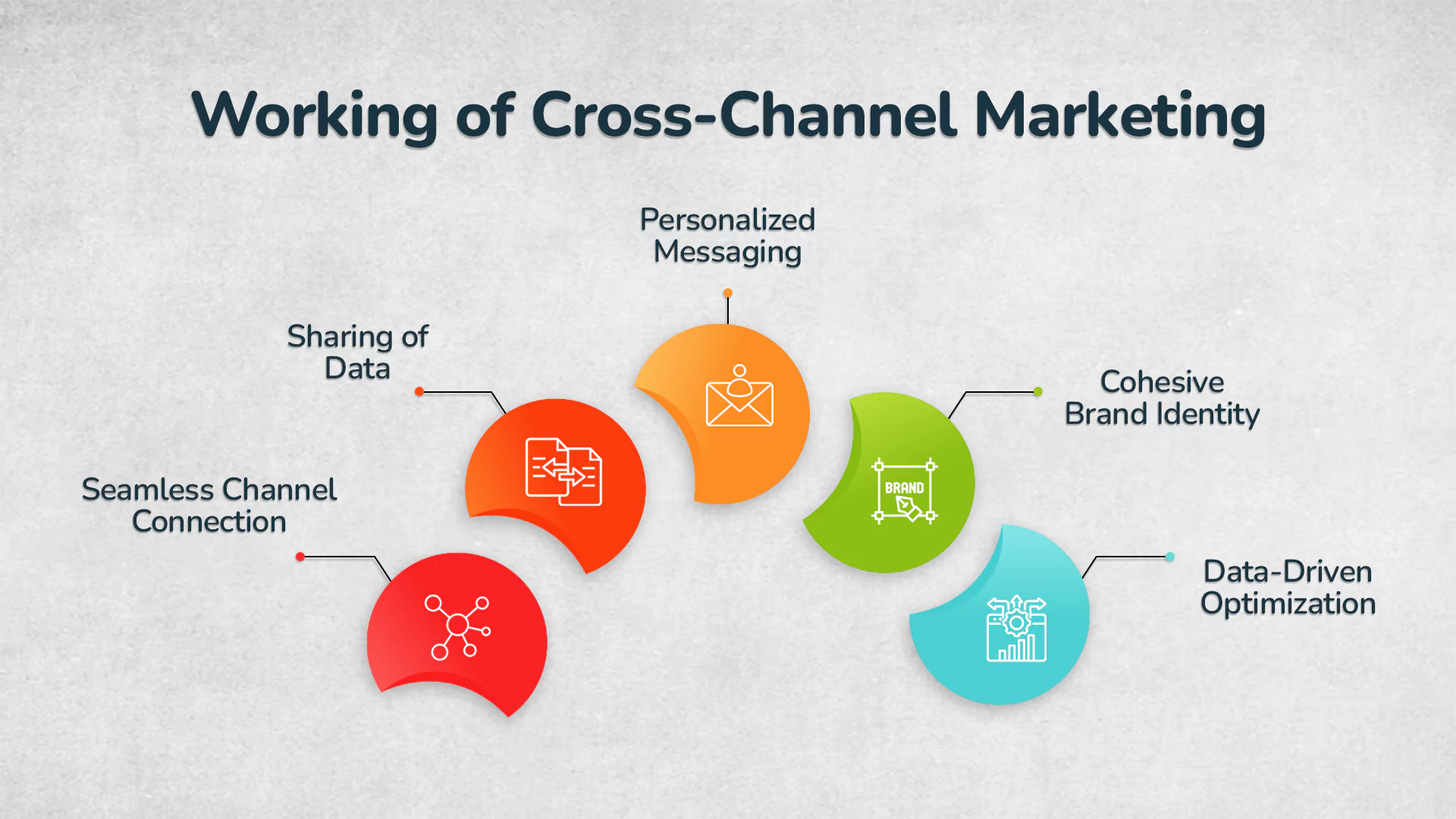
Here’s a detailed breakdown of cross-channel marketing:
1. Seamless Channel Connection
Primarily, all the marketing channels such as web, sms, email, in-person interactions, social media, etc., are integrated altogether.
2. Sharing of Data
The actions user’s perform on each platform, different channels collect and share it to the other channels, ensuring consistent messaging.
This provides a unified view of your potential prospects.
3. Personalized Messaging
With a holistic view of your prospects—every action they make on each platform, you can easily personalize messages and offer exactly what they are looking for across all channels.
4. Cohesive Brand Identity
You can show up on all channels with your brand’s aim, vision, mission, or tell about the products/services you offer, or educate your users with valuable content.
This ensures your brand identity remains cohesive and consistent across all channels, leading to increased brand recognition, visibility, trust, and customer loyalty.
5. Data-Driven Optimization
Finally, the user’s data, such as website visits, add-to-carts, link clicks, etc., is collected are used to create unified customer profiles.
This improves the effectiveness of your marketing campaigns, such as refining campaigns, improving targeting, increasing response and engagements, boosting conversions, widening customer base, and ultimately, higher profits and ROI.
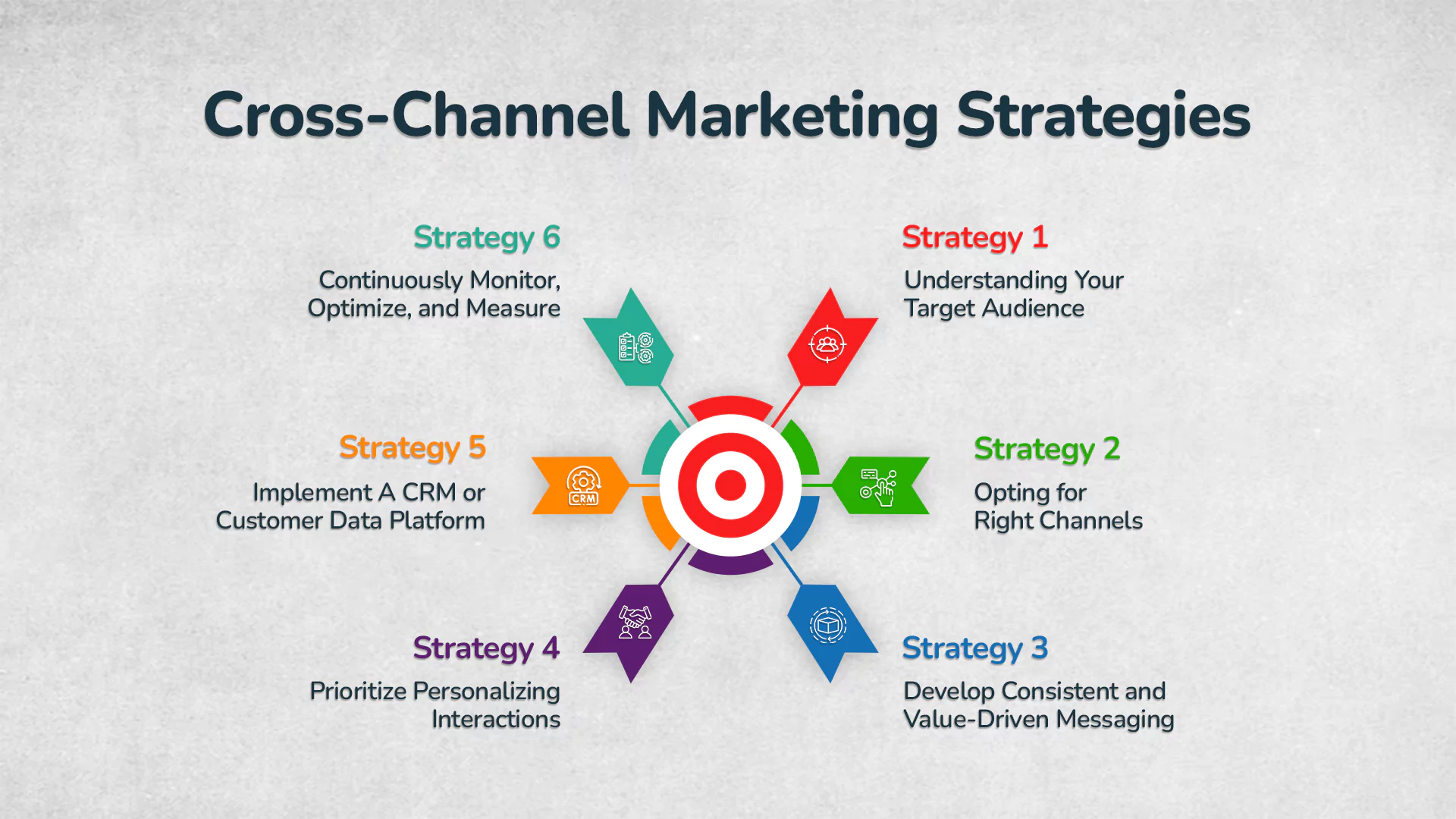
Now that you have an idea of how cross-channel marketing works, let’s look at the strategies for launching a cross-channel marketing campaign.
Underlining The Tried & Tested Strategies!
A recent study highlights, brands with strong cross-channel strategies achieve an average 89% customer retention rate compared to 33% for those with weak strategies.
So, continue reading the blog to master the expertly tested and proven cross-channel strategies, and retain a vast number of loyal and paying customers.
Strategy1
Understanding Your Target Audience
Knowing your target customers inside out is the primary part of cross-channel market strategy. If you know the audience’s needs, pain points, preferences, preferred communication channels, behaviors, etc., you can curate messages that completely resonate with them, and make it available on all communication channels.
This would ensure higher engagements, responses, and conversions for your campaigns.
Therefore, it is highly advisable to get an in-depth view of your targeted prospects.
Strategy2
Opting for Right Channels
Understand the different marketing channels available, and conduct an in-depth research to know on which channel your target audience is most likely to present looking for your business.
This strategy would help spread your brand message across a wide range of audience, helping you gain a huge customer base.
By selecting the channels that perfectly align with your potential prospects and marketing goals, you can create a seamless and engaging customer journey across various platforms.
It ensures effective reach, personalized experiences, ultimately driving higher sales and customer loyalty.
Strategy3
Develop Consistent and Value-Driven Messaging
You must ensure that your message provided across all marketing channels is consistent. It should strictly align with your company’s values, and visions.
Tip from Personal Observation: Few companies, for some channels they’ll mention data accuracy 98%, and for others 99% accuracy. This leads to nothing but loss of customers’ trust in your brand, resulting in losing “leads” that were almost converted. So, kindly avoid mentioning information that seems misleading—voluntarily or involuntarily.
Strategy4
Prioritize Personalizing Interactions
When a user makes an action on channels, use that data to personalize further interactions such as sending targeted email campaigns, or sending relevant ads, or offering similar product recommendations.
For instance, if a customer views a product on a website, a subsequent email could offer a discount or highlight similar items, based on their browsing history, and similar ads would pop on their instagram, facebook, etc. This is exactly how you can personalize interactions depending on the channel.
Strategy5
Implement A CRM or Customer Data Platform
You must centralize customer data from all channels in one single platform i.e., CRM to get a unified view of your target audience.
By getting a complete overview of the target audience in a single place, will help you analyse and target effectively.
By understanding which channels are most effective for connecting with specific customer segments, organizations can optimize their marketing spend and ensure that their campaigns are delivering the highest ROI.
Strategy6
Continuously Monitor, Optimize, and Measure
When you have successfully launched cross channel marketing campaigns, your work is not finished!
Your work starts now!
You must continuously track key performance metrics such as website traffic, customer engagement, response rate, conversion rates, etc.
If there’s any downfall, you must try and analyze the reason behind it, and what necessary measures can be taken for improvement.
Therefore, kindly note, continuous monitoring, tracking, and optimizing the cross channel campaigns is crucial.
What Are The Benefits of Cross-Channel Marketing?
Already, throughout the blog, we’ve been mentioning the advantages cross channel marketing would offer.
To ensure you get a clarity and good understanding of “what exactly is the benefits” we are highlighting below:
1. Meet Customers Where They Are Present
Launching cross channel marketing ensures businesses meet “ideal prospects” across multiple touchpoints.
Regardless of channels such as email, sms, direct mail, offline stores, etc.,you can reach out and market your products, services, or solutions across any channels easily and effectively.
2. Boost Response and Engagement Rates
Implementing cross channel campaigns helps you tailor messages that align with your target audience preferences and pain points, thereby delivering better responses and engagement rates to your campaigns.
Tip: Explicitly understand who is your target audience, their pain points, needs, struggles, etc.
3. Close Deals Instantly
Using cross-channel marketing to secure deals instantly is possible. Moreover, it helps you to target customers on the right channel at the right time.
How?
As, you get notified of every action they make, ensuring the right timing to engage and sell your offerings.
This would help you gain a huge sales for your business, contributing to closing deals.
4. Get Interested, Loyal, and Paying Customers
Integrating highly targeted and result-focused cross-channel marketing allows access to customers—highly interested in your offerings, loyal, and ready to pay for your solutions.
Suppose, you run a cross channel campaign, if the buyer takes any action, you’ll automatically get notified, this would help you know who are highly interested prospects and also in which category.
Also, if someone is interested, surely they have the purchasing power, so you’ll get customers who are ready to pay the amount you offer your solution for.
5. Brand Recognition and Visibility
Utilizing cross channel marketing lets businesses be present across all channels, helping in enhancing brand recognition and visibility among the target audience segment.
“The More Number of Times You See Something, The More Likely You’re to Remember and Get Attracted Towards It—Mere Exposure Effect”
Therefore, cross-channel marketing does the same, pulling a huge number of prospects, by showing up your business across all existing channels.
6. Lower Customer Acquisition Costs(CAC)
Implementing cross-channel marketing strategically and effectively helps businesses like yours identify the most effective channels for acquiring customers.
It also helps to know on which channels your customers are most active and responsive, resulting in earning a huge customer base at minimal costs.
7. Higher Return on Investment(ROI)
When you can meet and engage with customers where they are actually present, secure deals easily, access sustainable customer bases(interested in your offerings), and more.
By default, you can see positive outcomes in your campaigns, a surge in ROI, and profits of your business.
What Are The Challenges Faced with Cross Channel Marketing?
Despite cross channel marketing being a powerful and strategic approach to connect, engage, and market, it presents various challenges.
The following are the challenges:
1. Inconsistent Messaging
You must tweak your promotional campaigns according to each channel and the type of audience you’re targeting.
But remember: your campaign’s headline shouldn’t differ, meaning, on facebook it is 15% off, instagram it is 20% off, etc. This shouldn’t be the case, as it leads to confusion among your target audience, and damages the company’s reputation.
To avoid such scenarios, develop comprehensive brand guidelines and ensure all teams follow a unified messaging strategy adapted appropriately for each platform.
2. Data Siloed and Integration
It’s not necessary that all the channels you’re using while cross channel marketing are running on the same system. Most of the time different channels operate on separate systems, making it challenging to understand customer data.
This results in inconsistent customer profiles and hinder personalization efforts.
To avoid it, incorporate marketing platforms or adopt a customer data platform(CDP) to unify for a holistic view of customer behavior.
3. Lack of Platform Integration
Managing and tracking numerous platforms can lead to disjointed campaigns and inefficiencies.
Therefore, you must integrate a centralized content calendar and use project management tools to ensure coordination across all marketing channels.
4. Complex Attribution
Determining which channel led to a conversion is often unclear, making campaign analysis and monitoring a challenging task.
However, you must utilize multi-touch attribution models and advanced analytics tools to more accurately track and evaluate performance across channels.
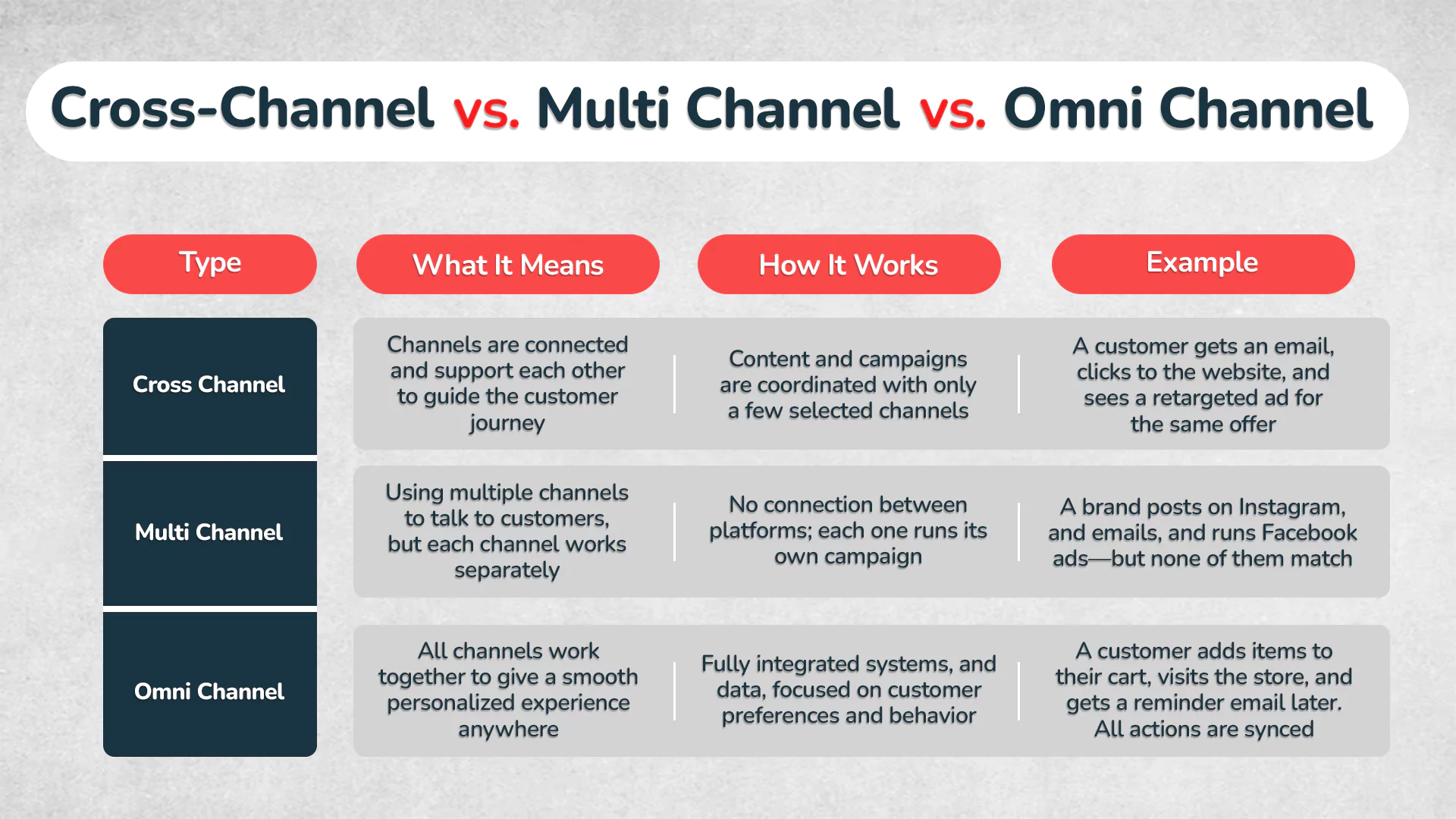
What’s the Difference Between Cross Channel Marketing vs. Omni Channel Marketing?
Majority of the people often get confused with cross channel, multi channel, and omni channel marketing.
Let’s quickly understand how cross channel marketing differs from both.
Ready to Meet Your Customers Wherever They Are?—Start Now!
Now that we’re at the end of the blog, you might have understood cross channel marketing.
So why wait?
Read it carefully and start launching cross channel marketing campaigns effectively and impactfully.
Meet, Engage, Connect, and Convert your target audience now!
Conclusion
Remember, just executing cross-channel marketing campaigns won’t get you positive results, it’s important to deliver information that caters to specific customer needs.
According to a recent study, personalized cross-channel marketing, where brands deliver tailored messages across multiple touchpoints (email, social media, etc.), is gaining significant traction.
You must form a unified customer experience across channels such as social media, email, sms, etc.
Therefore, marketers and businesses must start integrating personalized messages in cross-channel campaigns for business growth and development.