
Productivity is the cornerstone of a lead generation campaign. One slip can abruptly disrupt all efforts put into marketing. So, it is most important to keep things running – like sending emails to prospects, personalizing the sales pitch, tracking the performance of campaigns, and eventually repeating the tasks again.
After all, engaging prospects and nurturing them for conversion requires exemplary focus and constant follow-ups on your campaigns, right?
If you are just running email campaigns, maybe the pressure can be fine to handle. However, multichannel campaigns require support and solutions to manage lead nurturing. Thus Marketing Automation helps businesses and marketers handle a broader range of marketing tasks across multiple touchpoints.
This article post is a detailed explanation of marketing automation and its significance in lead generation and customer journey.
DID YOU KNOW?
“Almost 80% of the businesses worldwide use some kind of marketing automation platform or tools to run their campaigns”
What is Marketing Automation?
Marketing Automation is a software used to streamline marketing tasks. Businesses use marketing automation platforms to manage repetitive marketing tasks automatically.
Marketing automation simplifies workflow and helps personalize marketing campaigns. With predefined rules and patterns, marketing automation platforms can automatically share content with prospects in line with different stages of a marketing funnel.
With the help of a proficient and effective marketing automation tool, businesses and marketers can manage multiple tasks like email campaigns, lead nurturing, lead scoring, social media automation, reporting and analytics, etc.
How Does Marketing Automation Work and What Does It Do?
If you haven’t utilized marketing automation tools so far, then this will give you a proper understanding of its operations. So, 5 major components of marketing automation allow for an efficient customer acquisition process. This includes:
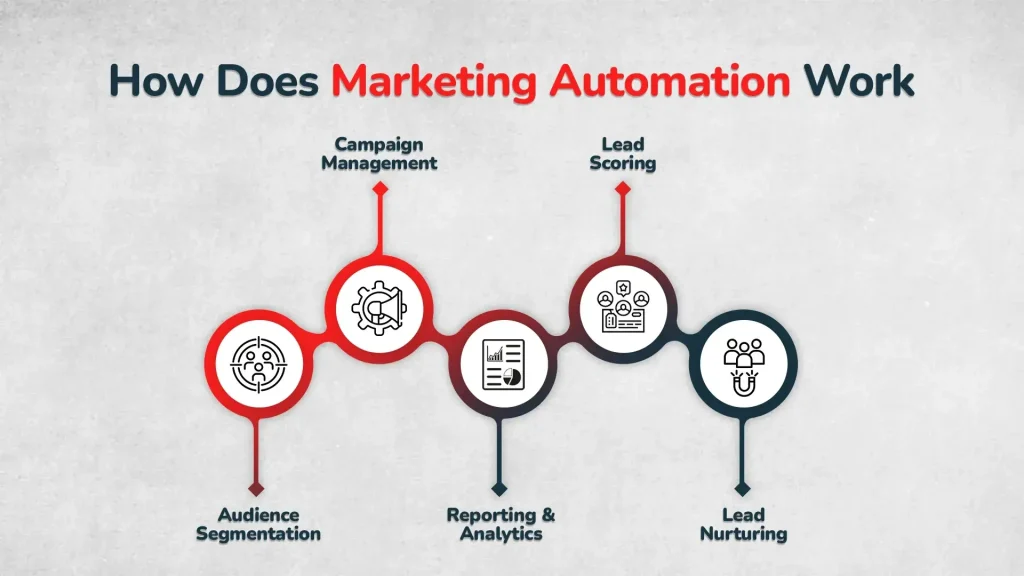
- Audience Segmentation: Marketing automation tools can segment audiences based on their characteristics like demographics, firmographics, and technographics.
- Campaign Management: This involves managing marketing activities across multiple channels, including emails, social media, and websites.
- Lead Scoring: The system will assign scores to your leads based on their relevancy to your business or based on any instruction you prompt to the automation platforms.
- Lead Nurturing: Automated, yet personalized messages are sent to leads to nurture them into potential or actual customers.
- Reporting & Analytics: Marketing automation platforms can prepare and report metrics, like website visits, email opens, clicks, social media engagement, and more, to trigger specific actions.
Even though these can be manually done by sales and marketing teams, there is no guarantee of predictive analysis, timely completion of tasks, and lead management. Hence, marketing automation has become a significant part of the campaign process.
To reduce manual intervention and eliminate the need for professionals to work on repetitive tasks, companies use marketing automation platforms and tools. So, in simple words, marketing automation is used for email marketing campaigns, social media management, lead nurturing, and productive control of mapping a customer’s journey.
Moreover, marketing automation can coordinate personalized, timely, and relevant interactions with prospects and customers across multiple touchpoints. For example: If you have a prospects’ contact list, you can utilize the data in it and send automated emails featuring your products and services to all the prospects. You can set parameters for the emails accordingly so that it personalizes each email sent to your potential customers.
As the example states, the same can be done at any stage of the marketing or sales funnel. You can send automated emails to your prospects and customers or share automated content through other forms of marketing campaigns. This eradicates manual labor and enables you to focus on strategic initiatives and sales, and improve the overall operations of your business.
Marketing Automation Tools
Since marketing automation is a process, you need reliable tools or platforms to carry out the process. Even though there are numerous marketing automation tools, some of them have gained global reputation and recognition for their efficiency.
These tools streamline repetitive marketing tasks with rightly set workflows. Installing marketing automation tools has become more than a necessity for companies, as they swiftly automate different steps of a sales funnel to enable customer acquisition.
Moreover, some of the top marketing automation tools provide unique features that are sound to their reputation.
The 5 Top Marketing Automation Tools to Consider for Your Business!
- HubSpot
- MailChimp
- ActiveCampaign
- Marketo
- Klaviyo
1. HubSpot
HubSpot enables marketing automation within its CRM platform to automate and streamline marketing tasks such as email campaigns, lead tracking, sales analytics, etc.
2. MailChimp
The best email marketing automation tool in business – known for its ability to allow users to send personalized messages to potential prospects automatically.
3. ActiveCampaign
They provide AI-powered marketing automation tools. They allow businesses to send emails and content through various channels when triggered throughout a marketing funnel.
4. Marketo
Known as Marketo Engage, it is a marketing automation platform that helps businesses drive results through personalized automated campaigns.
5. Klaviyo
Klaviyo is best known for email and SMS automation. They provide a drag-and-drop flow builder tool to simplify workflows in a customer journey.
Apart from these tools, there are other honorable mentions such as Salesforce Pardot, Ortto, Brevo, and Hootsuite that businesses worldwide depend on for their automation needs.
Now that you know how marketing automation can be useful for your business and the tools to consider installing – let’s learn about the challenges and common pitfalls of marketing automation.
What are the Common Challenges Faced While Using Marketing Automation Tools?
Despite its potential, marketing automation can fail without a strong foundation. So, it is best to assess what could go wrong in marketing automation. Here are the challenges:
- Poor Data Quality: Without proper data, there is no point in initiating marketing campaigns, with or without marketing automation tools. The core of marketing relies on quality contact data. So, for accurate, verified, and authentic contact information of prospects – connect with TargetNXT.
- Inefficient Workflow: This can cause havoc in your campaigns. If your marketing automation system has any technical errors, or if you have not given clear automation instructions, then the workflow and logic will take a hit. This will disrupt the entire automation process.
- Bad Content Marketing: Unless your marketing automation tool is AI-powered, having irrelevant content scheduled in your system will highly affect your lead generation and customer acquisition process.
- Personalization: This is a must-have in any marketing strategy. If not personalized, then you can no longer engage prospects. Personalizing your marketing automation, even during triggered actions on customer behavior is vital.
- Over-Automation: Relevant to the workflow, over-automation will end up giving an impersonal customer experience. Bombarding leads with irrelevant messages or neglecting the human element can damage trust.
- Lack of Monitoring: Even though we rely on technology to ease our workload, it is highly important to monitor and refine the workflow. If left unchecked, it could damage your marketing campaigns, as well as your brand.
What are the Benefits of Marketing Automation?
The benefits of marketing automation are:
- Automated tasks: No manual intervention, no working on repetitive tasks. With marketing automation, you can focus on other aspects of your business.
- Lead nurturing: More efficient and effective lead nurturing is made possible through marketing automation platforms.
- Personalized customer experience: Marketing automation systems can analyze customer behavior to send targeted and personalized messages.
- Data-driven Insights: A key benefit of implementing marketing automation is its capability to provide reports and analytics of marketing campaigns.
- Better ROI:With efficiency, you get more leads; with more leads, you get more customers; with more customers, you get more sales; and with more sales, your return on investment is higher.
“Around 70% of marketers have stated that they witnessed a positive ROI within the first term of implementing marketing automation for their business.”
How to Measure the Success of Marketing Automation?
For businesses that are unclear about how to determine if the strategies implemented through your marketing automation platform are successful or not – here are some of the metrics to follow.
- Conversion Rate by Workflow
- Customer Lifetime Value (CLV)
- Cost per Lead/Acquisition
- Revenue per Campaign
- Engagement-to-Close Time
Undoubtedly, marketing automation platforms are the building blocks of successful lead generation and customer retention. But the foundation of any marketing campaign has to be ‘data’.
That’s right! If not for real-time contact information of prospects, you’d be wasting all your time, money, and efforts on automation tools that are never gonna help you.
TargetNXT – the global leader of B2B data intelligence, is here to set things straight for your marketing campaigns. No matter the marketing automation platform, TargetNXT’s email lists or contact databases provide accurate data that can be integrated into your CRM and used for prospecting through automation tools.
Acquire 100% verified data to execute 100% result-yielding marketing campaigns.
Conclusion
Customer experience determines the result of your marketing campaigns. Build a world-class customer experience through marketing automation.
Elude generic strategies and opt for modern takes on impressing prospects. Lead generation is a universal concept in the B2B landscape and implementing marketing automation is a clear advantage for customer acquisition.
Start small with email marketing automation workflow and move ahead to tactics across every touchpoint. To wind up, companies that avoid marketing automation tools have to start before your competitors take over.