
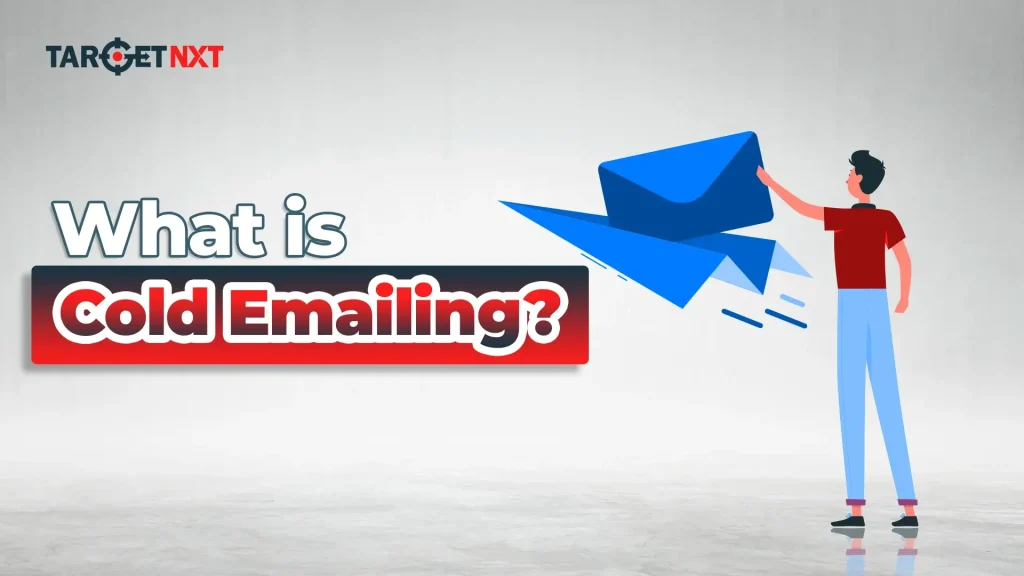
Cold Email refers to emailing people or businesses with whom you do not have any prior relationship. It is often used for outreach purposes such as sales, networking, or marketing.
Cold emailing is one of the perfect tools used by businesses in the competitive world but still sounds pretty intimidating. If you ever thought about how to reach out to someone without having any previous contact information, you’re definitely not alone. In this blog, we’ll pull the way through the ropes of cold emailing with some real-time examples and share some tips on how to make your emails stand out in an already jam-packed inbox.
Overview
Cold email often means emailing people or businesses with whom you do not have any prior relationship. Unlike spam, which is transmitted like mass messages and generic letters, a cold email directly targets the recipient and creates a bond toward networking, partnership, sales, and many more.
Before understanding in detail about cold emailing, the foremost thing anyone looking to cold email should know is whether you can do it legally across the globe or if there are any specific compliance policies that need to be followed.
The Legal Landscape of Cold Emailing: A Global Perspective
Cold emailing can be a magic wand for businesses and marketers, though the legality differs dramatically from one end of the globe to the other. With 195 countries under the United Nations banner, each country has its own set of rules that could either make or break your email outreach efforts. Now, let’s jump into this complex mess of laws!
The Nitty-Gritty on Cold Emailing
Basically, cold emailing is a message to an individual or company without any established contact. Although it is one of the most popular strategies, there are legal implications that need to be navigated in order to avoid steep fines and reputational costs.
Key Regulations by Region
1. United States
The CAN-SPAM Act regulates commercial emails. Commercially related email senders must offer an opt-out option easily accessible to the recipient and are not allowed to use misleading subject lines. In 2021, the FTC received over 4.5 million complaints related to email spam, and, therefore compliance is of extreme importance in such matters.
2. European Union
It’s pretty tight with the General Data Protection Regulation. You will need explicit consent for emails, which can get pretty messy with cold outreach. A survey revealed that 64% of businesses were unaware of GDPR’s impact on their marketing strategies.
3. Canada
CASL is a very strict law, and even makes it a law that commercial senders obtain explicit permission. Punishers might even receive $10 million in fines. 45% of businesses do not currently comply with CASL as per a report.
4. Australia
The Spam Act contains an address requirement and a link to unsubscribe from any unsolicited emails. Repetitive offenders could have penalties of more than $1.1 million if they break the Spam Act.
5. Asia
Regulations vary widely. Countries like Japan have stringent laws requiring prior consent, while others, such as India, are still developing their legal frameworks. A 2020 survey indicated that only 30% of Asian companies understood the legal landscape of cold emailing.
Best Practices for Compliance
To engage effectively without running afoul of the law, consider these tips:
Know the Law: Research the specific regulations in your target country.
Obtain Consent: Whenever possible, seek explicit consent before sending emails.
Provide Value: Ensure your content is relevant and valuable to your audience to reduce unsubscribe rates. Be Transparent: Identify yourself and provide a straightforward way to opt out.
Anatomy of a Perfect Cold Email
If ever you want to write a successful cold email, then it’s all about the following core elements:
Only 23.9% of sales emails are opened. This means that a significant portion of cold emails remain unopened, which highlights the importance of crafting effective subject lines and ensuring your email doesn’t get lost in the inbox.
A targeted, highly relevant list will increase your chances of getting more opens.
a. Subject Line
That is going to be your first impression of your mail. Try to make it as enticing, clear, and to the point so the recipient would grab the attention of it. According to recent statistics, cold email campaigns with longer subject lines get a 24.6% higher response rate.
b. Customization
Personalized email enhances response rates. Use the recipient’s name and mention relevant information about his work or successes. According to recent statistics, name-personalized subject lines have an average open rate of 43.41%. For better results, combine it with other personalization techniques. Such as the recipient’s name + pain point of your recipient.
c. Value Proposition
Make it clear what you can offer. Explain why a recipient should care about receiving your email, whether he needs insight, collaboration opportunities, or solutions to his pain points. A recent study confirmed that pain point-driven subject lines work and have an open rate of 28%.
d. Call to Action (CTA)
End with a clear call to action. Schedule a call. Ask a pointed question. Make it easy to say yes. An original study proved that “interest CTAs” have a success rate of 30%, double the success rates of any other type of CTA.
e. Signature
Include your contact information and professional signature to build credibility.
Tips for Writing Cold Emails
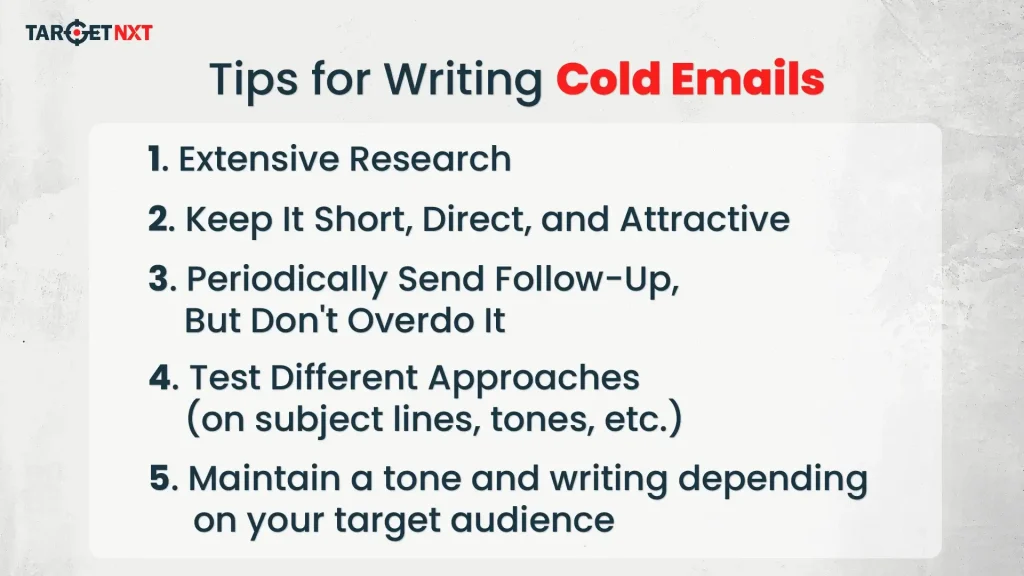
Do Deep Research: Understand the role, interests, and most importantly pain point of your recipient. It shows respect for their time and can personalize your email.
Keep It Short and Sweet: Professionals like concise emails. Keep your written words within 200 words and maintain clarity.
Follow-Up, But Don’t Overdo It: When you don’t get a response, a friendly follow-up can work. Wait at least a week before writing again with something as straightforward as “Just checking in.” Follow-up emails increase the chance of getting a reply by 21% (first follow-up) and 25% (second follow-up). Not following up regularly can result in missed opportunities.
Test Different Approaches: Try out different subject lines, tones, and formats to find what seems to work best for your crowd.
Mind Your Tone: An email should have your voice but be professional. Your tone should be conversational yet authentic.
Key Insights for Building a Successful Cold Emailing List
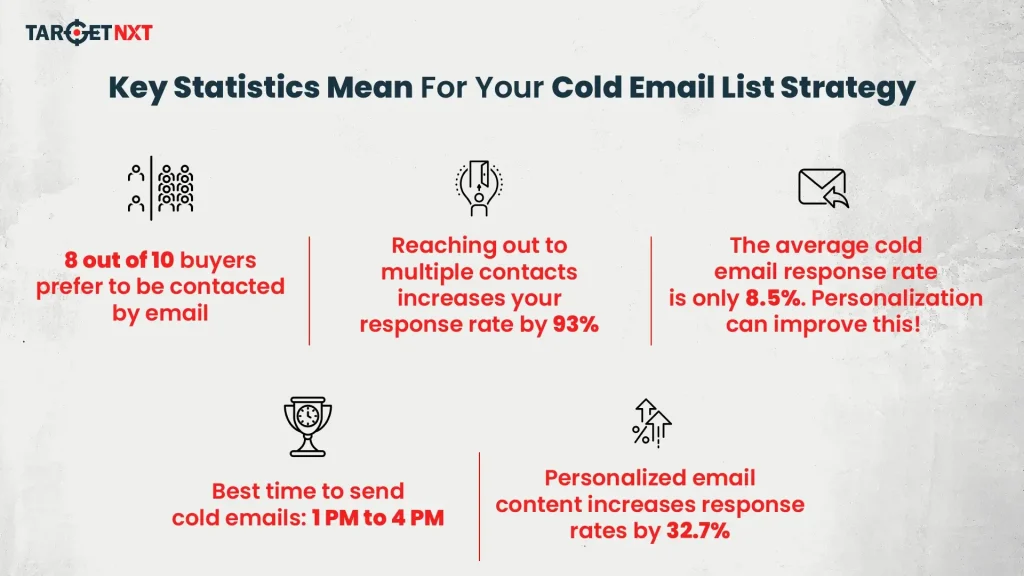
Cold emailing remains a powerful tool for reaching prospects, but success depends on targeting the right audience and optimizing your approach. Here’s what the key statistics mean for your cold email list strategy:
1. Cold Emails Are Preferred by Buyers
8 out of 10 buyers prefer email over other methods like phone calls.
Takeaway: Focus on building a list of buyers who are comfortable with email communication, allowing them to engage at their convenience.
2. Multi-threaded Outreach Boosts Response Rates
Reaching out to multiple contacts within the same company can increase your response rate by 93%.
Takeaway: Don’t rely on a single decision-maker—target multiple contacts within each company to maximize engagement.
3. Cold Email Response Rates
The average cold email response rate is just 8.5%, but personalization can improve this.
Takeaway: Build a high-quality list of qualified leads, and use tailored messages to improve your chances of getting a response.
4. Best Time to Send Emails
Emails sent between 1 PM and 4 PM tend to get the highest engagement.
Takeaway: Schedule your cold emails to arrive during this window for the best chance of being seen and opened.
5. Personalized Content Increases Response Rates
Personalized emails can increase response rates by 32.7%.
Takeaway: Segment your list and tailor your emails to address specific pain points or needs to drive better engagement.
Why Use Cold Emailing?
Opportunities for Partnership: Broaden your professional networking by reaching out to industry giants or professionals.
Development of your Business: Generate leads and establish connections with potential prospects.
Feedback and Insights: Gain valuable insights from industry experts to refine your products or services.
Various Use Cases of Cold Emailing
Cold emailing is often associated with something being done wrong, but when done right, it can be a game-changer. If you’re expanding your network, generating leads, or even finding a new job you can do all these using cold emailing. Here are a few of the top use cases where cold emailing can shine:
a. Lead Generation
Cold emailing is efficient in reaching out to potential customers you may never have heard of before if you are in sales or running a business. In simple terms, it means creating a personalized email that speaks to their pain points – opening up new opportunities and starting a conversation that leads to sales.
b. Networking
Don’t underestimate the power of a simple cold email to connect with industry peers or potential mentors. Whether you seek counsel or potential collaboration, a well-crafted message, can be the first step toward building relationships of value.
c. Job Search
The value of cold emailing cannot be understated: it can be pure magic in your job search. By reaching out directly, you can target and thoughtful messaging to the hiring manager can set you apart from applicants over a pile.
d. PR Outreach
Journalists and PR pros use Cold emails to pitch stories or ask for media coverage. This heightens awareness of your brand or clients.
Truly, when coupled with a genuine and strategic approach, cold emailing can unlock infinite possibilities. So take the leap of faith and don’t be fearful to take that first step.
Common Mistakes to Avoid
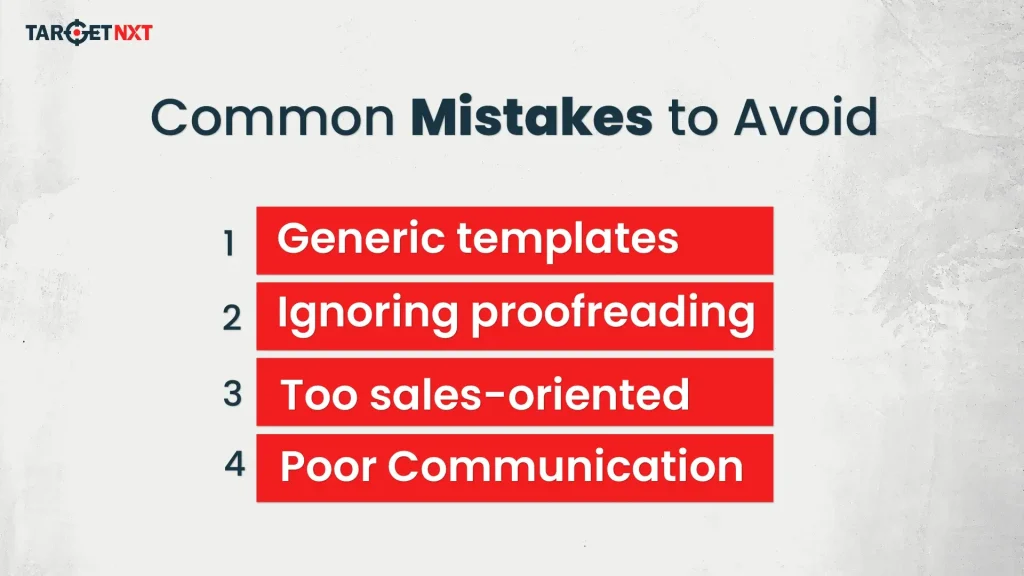
Generic templates: While templates are useful, tailor them for each recipient. Generic emails are mostly ignored.
Too sales-oriented: Cold emailing is not all about pitching products. First, build the relationship, and sales will naturally follow.
Ignoring proofreading: Spelling and grammatical errors can affect your professionalism badly. Always proofread before hitting the send button.
Poor Communication: If your e-mail doesn’t clearly state intent, then the receiver likely won’t respond. Specify what you need right off the bat.
Interactive Activity: Write Your Cold E-Mail!
Now that you have a solid understanding of cold emailing, it’s time to put that knowledge into practice! Try this activity to assess how well you can apply what you’ve learned. If you encounter any difficulties, refer back to the relevant sections above for guidance. Take note of any challenges you face and use the strategies you’ve learned to improve.
To make this more fun, let’s try an activity. Presumably, you are attempting to contact physicians all around the world and your company needs to sell healthcare-specific products. Compose your cold email in this exercise:
Subject Heading: What will pique his or her interest?
Hello Greetings: How do you plan on greeting them?
Opening Line: What are you going to talk about their work?
Value Proposition: What value are you going to deliver?
Call to Action: What specific ask are you going to make?
Take a minute to write that out. When you’ve drafted it, think of sending it off to someone else for some feedback.
Email Marketing vs Cold Emailing: What’s the Difference?
After going through the dos and don’ts of cold emailing, you may still ask yourself a question: how does it differ from email marketing? Let’s make it clear and help you to become a pro in cold emailing! Two terms often appear when discussing how to reach potential customers: email marketing and cold emailing. Though they look something similar, they serve two different purposes and use different approaches. Let’s break it down in terms that are relatable and easy to understand!
Email Marketing: The Warm Hug
Think of email marketing as having a cozy movie night with your friends. You already have a rapport with them; they are already on your guest list, as they have subscribed to receive your invites. So why is it different?
Opt-in Audience
Your subscribers have opted into sharing their email addresses with you, typically after receiving some kind of value for that-e.g. a discount on something or a free eBook. This is similar to your friends saying, “Sure, I’ll come over for popcorn and a flick!”
Targeted Content
Email marketing allows targeting audiences so that you can offer a special promotion to loyal customers while you send a newsletter full of tips and tricks to a wider list. The entire purpose is to serve relevant content for groups.
Analytics and Tracking
Just like you might gauge which movies your friends enjoyed by their reactions, email marketing provides robust analytics. You can see open rates, click-through rates, and even conversions. This data helps you refine future campaigns.
Example: A clothing brand sends out a monthly newsletter to its subscribers detailing new arrivals, styling tips, and other discounts on sales. Everyone on the list knows what to expect and waits eagerly for it!
Cold Emailing: The Bold Introduction
Now, cold emailing feels almost like you are approaching somebody at a party that you have never met before. You take a risk and get a little unnerved! Here’s the difference between this and email marketing:
1. Unsolicited Outreach
Cold emails to people who haven’t opted in for hearing from you. Here, you are, in essence, introducing yourself to see if that person responds positively to what you have to offer. This can feel a bit like crashing a party uninvited—some may appreciate it, while others might not.
2. Direct Approach
The goal is often to start a conversation, whether it’s for sales, networking, or partnerships. You want to hook the recipient’s interest quickly. It’s all about that initial impression!
3. Less Personalization
You can personalize cold emails to an extent, but they generally lack the depth of email marketing strategies since you do not have prior insights into the recipient’s preferences.
Example: You are a freelance graphic designer who wants to reach out to a tech startup you admire. You send them an email showcasing your portfolio, explaining how your design skills could elevate their brand even though they have never heard of you before.
Key Takeaways: The Contrast
Connection: Email marketing thrives on established relationships; cold emailing is all about making new ones.
Audience: Email marketing is aimed at subscribers who have opted in, while cold emailing targets potential customers without prior contact.
Content: Email marketing often delivers curated, relevant content; cold emailing focuses on a direct pitch or introduction.
So, whether you’re nurturing existing relationships through email marketing or bravely venturing into cold emailing, understanding these differences can help you strategize your outreach effectively. Now, go forth and connect—just remember to know your audience!
Does Cold Emailing Work?
Absolutely! Cold emailing is a robust lead generator, and a great tool for networking, and business development. Perhaps intimidating at first, many professionals have made a good fortune through strategic outreach. So, let’s have a closer look at several real-case studies about how cold emailing works for others.
A Case Study on Its Effectiveness
Cold emailing can be an enormous tool for business, especially for consulting firms. Let’s explore a real-life case study featuring Jake Jorgovan, a creative strategist who successfully used cold emailing to land high-value clients, including Fortune 500 companies.
Two Approaches to Cold Emailing
Jake identifies two distinct strategies:
1. Quantity Approach
This method emphasizes sending a high volume of emails, relying on the idea that reaching enough prospects will inevitably lead to conversions. A notable example is Shane Snow’s campaign, which achieved a 1.7% reply rate through sheer volume.
2. Quality Approach
In contrast, the quality approach focuses on crafting fewer, personalized pitches. Jake recommends selecting around 20-25 “dream clients” and tailoring outreach to them.
Key Elements for Success
Regardless of the approach, creating at least one high-quality case study is crucial. This case study should clearly outline:
- The client’s initial situation before your intervention.
- The solution you implemented.
- The resulting outcomes include a glowing testimonial.
Choosing Your Target Audience
To maximize the effectiveness of your cold emails, identify an audience that resembles your case study client. For instance, if you’ve successfully worked with a tech company, target another tech company or one in a similar industry. Specificity is vital, as potential clients often believe their situations are unique and seek tailored solutions.
Finding Prospects
Utilize sales or trade organization directories specific to your target industry. This approach will help you compile a relevant list of prospects to reach out to.
Crafting the Perfect Cold Email
The effectiveness of your cold email hinges on personalization. Here’s a sample email script that helped Jake land a $4,250 client:
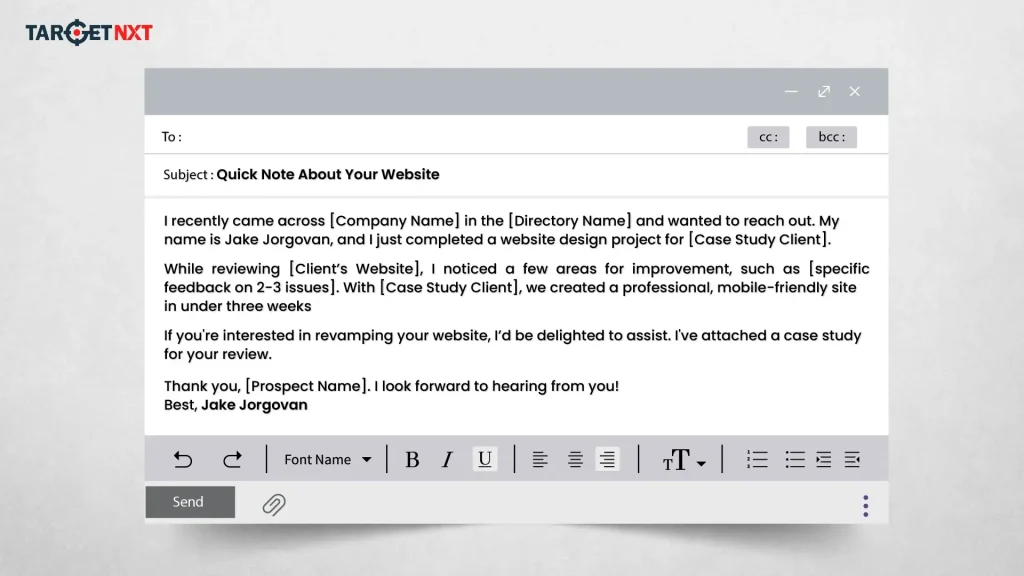
The Importance of Follow-Up
Jake emphasizes that the follow-up email is crucial. He typically sends a follow-up 7-10 days after the initial outreach. Here’s a sample follow-up script:
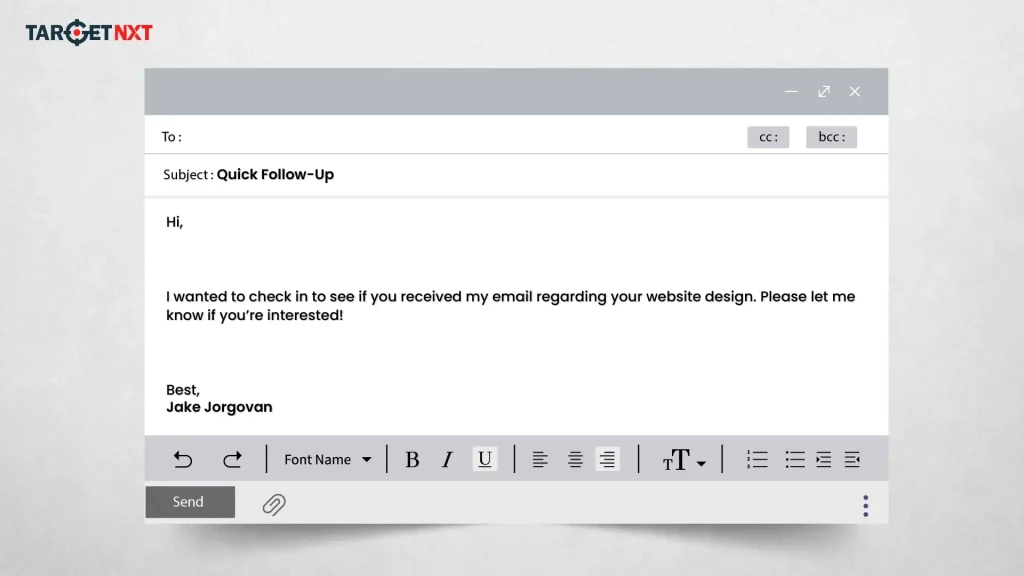
This case study illustrates that cold emailing when executed thoughtfully, can effectively secure valuable clients. By focusing on quality, personalization, and strategic follow-ups, you can significantly enhance your outreach success.
Wrapping Up
Cold emailing is daunting but, with practice and approach, opens exciting new channels. This aims to establish a relationship and build a connection just to sell something to someone. The way it’s done makes the right kind of impact. And by doing this, they will stand out in a sea of inboxes that make meaningful professional connections happen.
Remember these tips and examples next time you consider cold emailing. Your next huge opportunity is just one email away!