
Understanding U.S. Email Marketing Laws
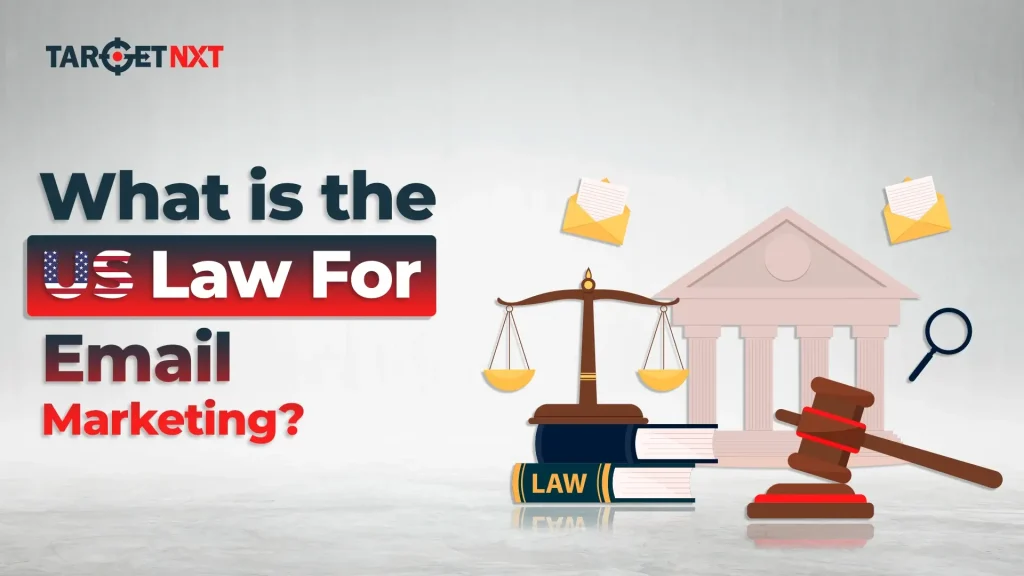
Email marketing is an effective tool for B2B businesses, providing a direct line of communication to potential prospects and clients. Therefore, gauging the legal arena can be daunting. Consequently, it’s crucial to know the laws governing email marketing in the U.S., including the CAN-SPAM Act, GDPR, HIPAA, CCPA, etc.
In this blog, we’ll deeply cover the detailed understanding of how to create compliant and effective email campaigns.
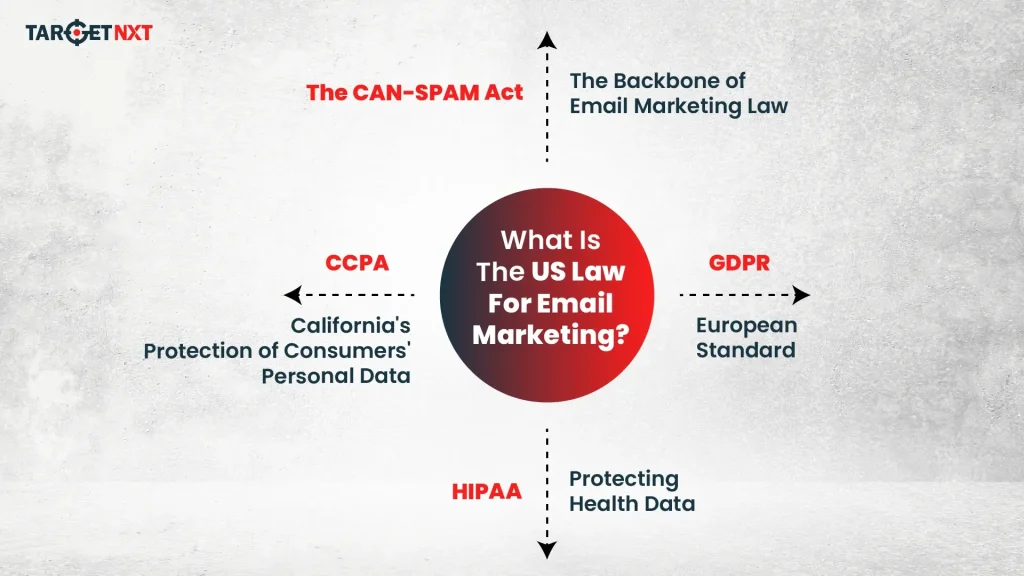
The CAN-SPAM Act: The Backbone of Email Marketing Law
Email marketing regulations are led in the U.S. by the CAN-SPAM Act of 2003. The CAN-SPAM Act of 2003 governs commercial email and focuses on misleading practices from consumers. Key requirements for the CAN-SPAM Act include the following:
1. No False or Misleading Information
Your emails should not bear misleading or deceptive subject lines or false information. The “From” and “To” fields should be for the sender. Honesty in the content of the email creates trust and sustainable relations with your potential prospects.
2. Identification
Emails must identify themselves as advertisements. A simple statement at the beginning of your email can suffice. Transparency is vital for maintaining credibility.
3. Opt-Out Mechanism
All emails must have an opt-out feature that is visible and prominent, such as an unsubscribe link at the bottom of your emails. It shall not be hard for an addressee to request his opt-out.
4. Physical Postal Address
The CAN-SPAM Act requires you to maintain your physical postal address at all times in all mail. This makes it somehow authentic and will be able to confirm your business.
5. Third-Party Emails Monitor
This would make you responsible for another company’s actions, too, if you outsourced the handling of your email marketing to them. Ensuring that you choose business partners who are very serious about these laws helps your business avoid being indirectly involved in such legal liabilities. At TargetNXT, we ensure our partners adhere to these regulations.
GDPR: European Standard
While the General Data Protection Regulation (GDPR) is a European Union regulation, it impacts U.S. businesses that engage with European customers. If you collect or process personal data from EU residents, compliance is mandatory. Here are some key aspects:
a. Consent
Consent must be explicit in order to send out marketing emails under GDPR. You should be using a double opt-in to ensure a user would like to hear from you.
b. Data Protection
The processing of personal data is secure and the storage with respect to measures for data protection is in place. Thus, all uses of the data have to be transparent by its recipients.
c. Right of Access and Erasure
The recipients should also be allowed access to the respective data and may delete this anytime. Ensure that systems have such provisions for implementing it as soon as requested.
HIPAA: Protecting Health Data
If your B2B email marketing campaigns touch on healthcare providers or organizations that handle PHI, then you are required to follow HIPAA compliance mandates. HIPAA is among those regulations that call for stringent safeguards to be taken regarding PHI. Here are the essentials:
1. Business Associate Agreements (BAAs)
If you provide email services to covered entities, you may be required to execute a BAA. The agreement outlines what you will do regarding PHI.
2. Data Encryption
All PHI that is transmitted by e-mail, should be encrypted in order to protect it against access by unauthorized individuals.
3. Minimum Necessary Data Use
Only use and disclose the minimum amount of PHI required to conduct your e-mail business. This doctrine of minimum necessary use forms the cornerstone of a HIPAA-compliant practice.
At TargetNXT, we emphasize the importance of HIPAA compliance in all our healthcare email lists curated for effective healthcare-related campaigns.
CCPA: California’s Protection of Consumers’ Personal Data
CCPA is another major legislation that impacts email marketing and specifically applies to businesses doing business in California. Some of its most prominent features are as follows:
a. Rights of the Consumer
CCPA offers some rights for a California consumer about his data. Some of them include:
- Know how the company is collecting your data.
- Erasure of collected data on their request.
- To be let alone; i.e., not selling data of a person.
b. Transparency
You must inform consumers what kinds of personal information you collect and how it will be used. This can be placed in your privacy notice, which should be easily accessible.
c. Right to Opt Out
Again, like the CAN-SPAM Act, there is a right to opt out of data collection. Make this an option for customers in your communications.
The Future of Email Marketing Laws
As technology evolves, so too does the regulatory environment. Keep up with emerging trends and possible changes in laws regarding email marketing. Use industry newsletters and social media subscriptions to follow legal experts to stay ahead of this curve.
Final Thoughts: Building Trust Through Compliance
Understanding U.S. email marketing laws, including the CAN-SPAM Act, GDPR, HIPAA, and CCPA, is crucial for any B2B email list provider. By adhering to these regulations, obtaining consent, and staying informed about state-specific laws, you can build a trustworthy email marketing strategy. Remember, compliance is not just about avoiding legal issues; it’s also about fostering relationships with your audience.
Get free from all legal issues faced while email marketing using personal contact information with TargetNXT’s 100% globally compliant email lists.