
Know Your Email Service Provider
The ESP remains one of the most influential players in contemporary digital communication, primarily in marketing and business relationships. This glossary explains the concept of ESPs, their functions, benefits, and key terms associated with them.
Definition of an Email Service Provider
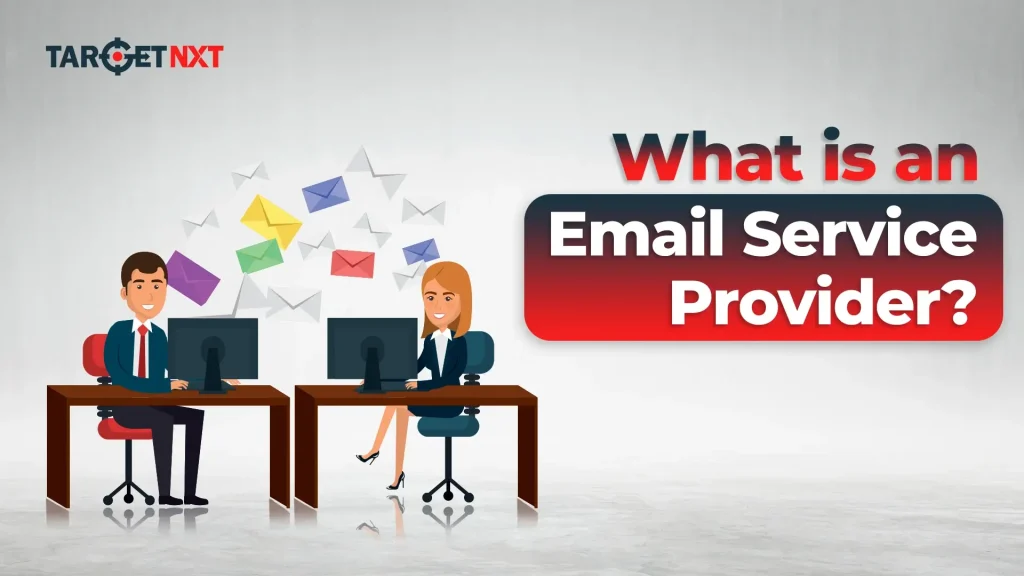
ESP stands for Email Service Provider, which is an email service company that provides services for email communications. It transmits, receives, and handles the overall email interaction. To make email marketing, transactional emails, and personal communications effective, ESPs offer tools to meet individual, business, and organizational needs.
Key Components of Email Service Providers
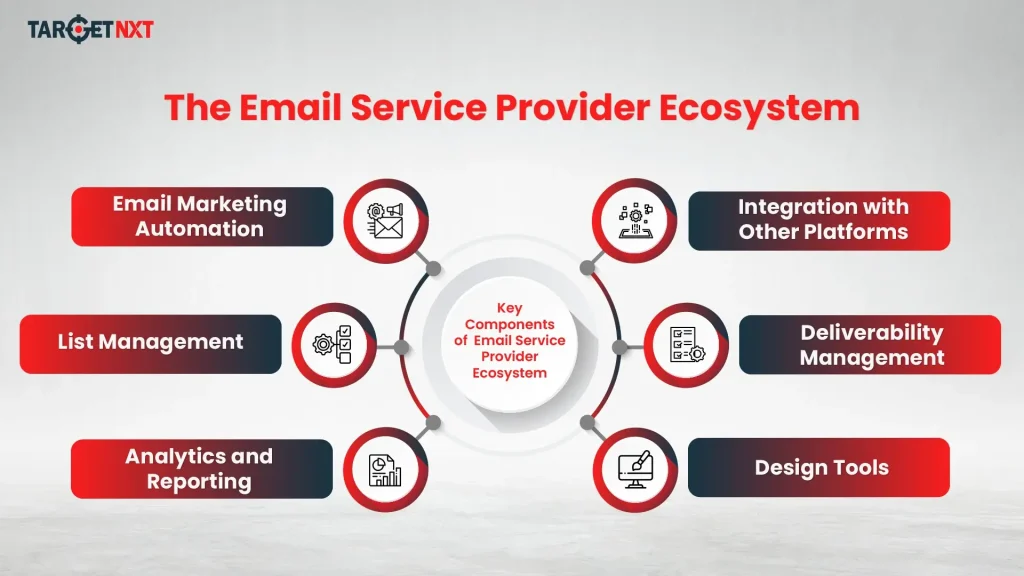
ESPs enable varied functions that enhance the efficiency and effectiveness of communications:
1. Email Marketing Automation
Many ESPs provide marketing campaign automation tools. Using these services, emails can be scheduled, targeted audiences divided up and categorized, and content tailored to user behavior patterns. Therefore, email marketing automation improves engagement and saves time for marketers.
2. Email List Management
Email Service Providers have features that help to manage and organize email lists. This may also include import contacts tools, listing based on various parameters, and all global compliances such as GDPR, CAN-SPAM, etc.
3. Analytics & Reporting
Most ESPs also include strong analytics to track the effectiveness of an email marketing campaign. Such measurements as opens, click-through rates, and conversions allow businesses to screen the effectiveness of their communications and to make data-driven decisions.
4. Design Tools
ESPs often have user-friendly design tools for the creation of well-designed emails that are not highly technical. Such usability is achieved through templates, drag-and-drop editors, and mobile optimization features.
5. Email Deliverability Management
ESPs integrate various techniques for better deliverability such as IP reputation management, feedback loops, and industry standards compliance. This ensures that the most critical aspect-that the emails reach the right inbox-is very much satisfied. Utilize TargetNXT’s best-regulated collections of email lists across diverse industries and achieve a 97% email deliverability rate.
6. Integration with Other Tools
Many Email Service Providers have integrated with other applications, including CRM systems, social media, and other e-commerce platforms. Its integration with other applications enhances the overall functionality, bringing it more towards holistic marketing campaigns.
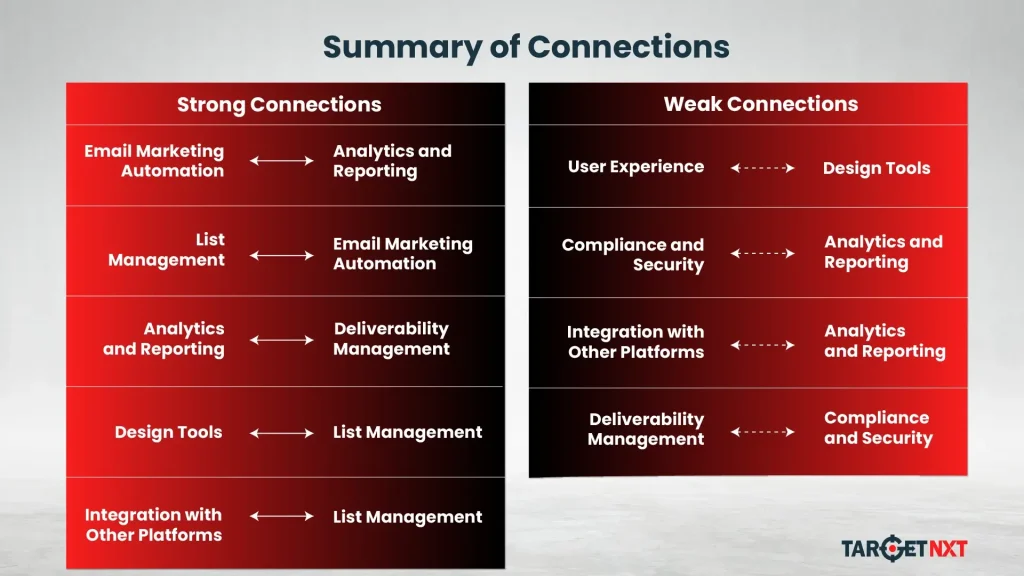
Strong Connections
Email Marketing Automation ↔ Analytics and Reporting
Reason: Automation relies heavily on performance metrics to adjust strategies.
List Management ↔ Email Marketing Automation
Reason: Effective targeting and segmentation in automation depend on well-managed subscriber lists.
Analytics and Reporting ↔ Deliverability Management
Reason: Deliverability directly affects performance metrics (open rates, click-through rates).
Design Tools ↔ List Management
Reason: Tailored designs for specific segments require data from list management.
Integration with Other Platforms ↔ List Management
Reason: Data sharing with CRMs and e-commerce tools enhances list management effectiveness.
Weak Connections
User Experience ↔ Design Tools
Reason: While a good design tool contributes to user experience, user experience also involves other factors (support, usability).
Compliance and Security ↔ Analytics and Reporting
Reason: Compliance impacts reporting, but analytics does not directly influence compliance measures.
Integration with Other Platforms ↔ Analytics and Reporting
Reason: While integrations can enhance data analysis, they do not directly affect analytics capabilities.
Deliverability Management ↔ Compliance and Security
Reason: Compliance affects deliverability, but they operate as separate functions that influence each other indirectly.
Benefits of Using an Email Service Provider
There are numerous benefits of using an ESP. Some of these features include:
a. Scalability
ESPPs cater to small businesses, mid-sized firms, and large corporations. An ESP can grow with a business and expand its scope of service to meet new requirements without any change in infrastructure at all.
b. Cost-Effectiveness
More importantly, leveraging an ESP is less expensive compared to having an in-house email solution. Most ESPs have tiered pricing plans to match any size budget and usage level, allowing even the smallest-appearing companies to adopt such solutions.
c. Expertise and Support
Most Email Service Providers are offering teams of experts that can guide and give best practices regarding email marketing. This expertise might be very useful, particularly for companies in their early stage of digital marketing.
d. Compliance and Security
Email Service Providers are very much aware of the legislation concerning email compliance and also install security measures to safeguard the data of their users. This helps businesses not encounter any legal issues and gain the trust of their customers.
e. Time Saving
By automating most of the email processes, ESPs help businesses save time, which could be utilized on some other important things like strategy development and customer engagement.
Email Service Providers Key Terms
You would benefit from knowing the terminology used with ESPs because it can help you understand what the provider can do and how the software works:
1. Opt-In/Opt-Out
Opt-In describes the way that a person subscribes to receive communications from a business or organization.
Opt-Out refers to the ability by which users can opt out of receiving emails from a particular sender, typically by the use of an unsubscribe link within the message.
2. Deliverability
Number of emails safely landing in the inbox, not in the spam/junk mail folders.
3. Bounce Rate
Percent of emails that could not be forwarded to the destination address. High bounce rates are often a sign of list quality issues or sender reputation issues.
4. Segmentation
Split your email list into a subset of smaller groups based on specific criteria such as demographics or behaviors that deliver content more targeted to each group.
5. A/B Testing
A technique comparing two versions of an email, such as in subject lines or content, to determine which one performs better, thus helping to optimize subsequent campaigns.
6. Responsive Design
A design approach that ensures emails are visually appealing and functional across various devices, including desktops, tablets, and smartphones.
7. Transactional Emails
These types of emails are generated based on the triggers initiated by the user actions are typically purchase confirmations, the reset of a password, and others. In general, such emails typically have higher open rates, and therefore, the clients use them for their purposes with customers.
Conclusion
Email service providers are communication tools through email in a technologically based world. They offer various functionalities that can help a business function, manage different marketing efforts using email, and therefore increase engagement and even the chances for deliverability. Knowing how to use an ESP, being familiar with common terminology, and its role can be used to perfect the use of these in marketing and even develop a stronger connection with an audience.