
Click-through rate is one of the most critical parameters in email marketing, which answers the question of how a particular campaign has performed. It indicates the number of recipients who had clicked on multiple links in a single email against the total number of delivered emails. It helps marketers understand engagement with the target audience and the general success of their campaigns for a rough outlook.
We’ll go deep into the concept of CTR, the factors that affect CTR, ways to enhance CTR, etc. in this glossary.
Overview
CTR stands for click-through rate. It is the ratio of recipients who have clicked on a particular link compared to the number of total recipients who opened and viewed an email. A simple formula to calculate CTR is as follows:
CTR= (Number of Clicks/Number of Emails Delivered)×100
For example, suppose you have an email campaign that was sent out to 10,000 recipients with 500 link clicks; your CTR would be at 5%.
Why CTR is Important?
Why do You Need CTR? There are Several Reasons For This:
- Engagement Parameter: The higher the CTR in your email campaign indicates that the content of the email has perfectly aligned with the target audience, thus, encouraging high engagement.
- Effectiveness of Content: It allows you to evaluate the working conditions of your subject lines, visuals, intent, and CTAs.
- Benchmarking: Marketers can differentiate their CTR from so many industry standards to measure the growth of their campaign.
- Return on Investment(ROI): Higher CTR leads to higher conversion rates and subsequently increases the ROI of your email marketing efforts.
Factors Influencing CTR
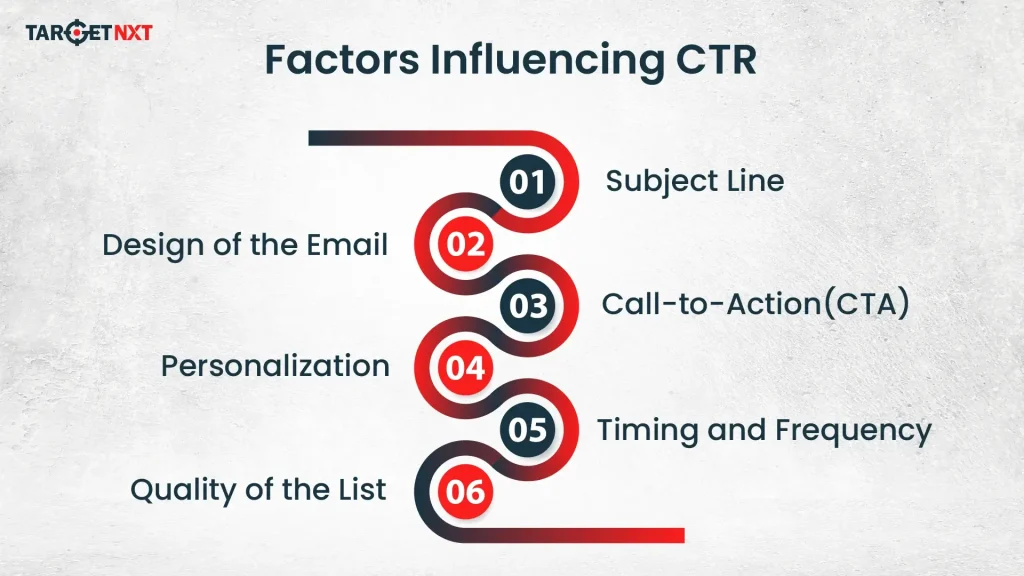
Several factors can influence the CTR of an email marketing campaign. Understanding these factors helps marketers create more impactful emails:
1. Subject Line
The subject line gives the first impression and as we say first impression is the last impression. Thus, an interesting subject line can convince the recipients to open the email, which will enhance the number of clicks.
2. Design of the Email
Visuals are always a good option. Visually attractive emails that can be read, understood and navigated easily can improve user experience and result in more clicks.
3. Call-to-Action(CTA)
Clear, concise, and actionable CTAs are a must. They must be devised in a manner that compels the recipient to know what action they must take next without ambiguity.
4. Personalization
Relevance and engagement can be enhanced by tailoring emails based on individual tastes, requirements, or behavior thereby increasing CTR.
5. Timing and Frequency
Balancing the right time(sending emails at the best possible times) and frequency will be the determinant of how many individuals are interested in the content.
6. Quality of the List
A correctly formatted and tested email list ensures that the right messages reach the right people, therefore increasing the chances of more clicks. Check TargetNXT’s email list be it of healthcare, technology, professionals, etc., all are of top-notch quality and score 100 on compliance, effectiveness, relevance, completeness, etc.
How to Improve CTR
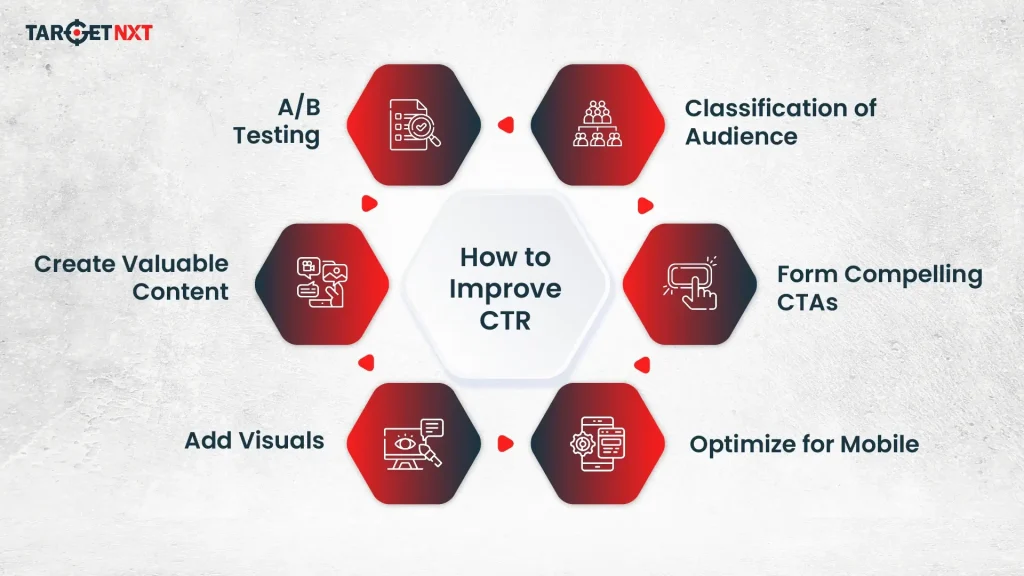
Improving CTR requires a tactical method. Here are several tactics marketers can use to improve click-through rates:
a. A/B Testing
Variation of email content in terms of subject lines, email layouts, or CTAs can give marketers an understanding of what works best for their audience. Therefore, A/B testing helps marketers make data-informed decisions.
b. Classification of Audience
Classification/segmentation of an email list based on categories such as demographics, engagement level, or purchase history. These classifications become helpful to marketers in making targeted communication that directly impacts the CTR.
c. Form Compelling CTAs
Use powerful words and action-oriented language to form a sense of urgency or excitement. Phrases such as “Get Your Discount Now” or “Grab 20% off” can pull in greater audience engagement.
d. Optimize for Mobile
Since most emails are opened on mobiles, ensure your emails respond well to mobiles, making it easy for a user to click links.
e. Add Visuals
Images, videos, and infographics can add interestingness to your email and get people clicking. Just make sure that the visuals are relevant and contextual to the content in the email.
f. Create Valuable Content
Providing information, offers, or resources of value to your audience will spur them to click on links to learn more.
Analyzing CTR for Campaign Optimization
After gathering the CTR of your campaigns through emails, you have to analyze it to benefit in future efforts. Here are the strategies on how to analyze and capitalize on CTRs effectively:
1. Benchmarking
It is a comparison of an appropriate benchmark-identified industry average with your CTR to understand where improvements are needed. This will provide context to your metrics.
2. Identify Trends
Find out the CTR patterns over time. Analyzing fluctuations in your CTRs will help understand what works and what doesn’t.
3. Content Evaluation
What types of content cause the most CTR? Are there certain topics that work better? Does the format of some content types do better than others? Do some types of offers work better than others?
4. Feedback Loop
Get feedback from the actual recipients in return via surveys and direct responses. Their thoughts will help determine your future content as well as future emails.
5. Content Adjustments
Using all the data that you have, refine your whole email marketing strategy by implementing that which has continuously got it to click.
Conclusion
Understanding and leveraging CTR, helps marketers improve engagement, drive conversions, and ultimately achieve greater success in their email marketing campaigns. However, all marketers must implement different strategies and tactics that drive their email marketing Click-through-Rate(CTR). Utilize TargetNXT’s email lists across different industries and make your CTR reach heights.